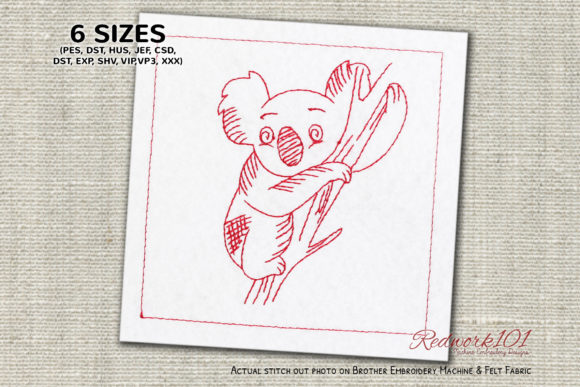
Baby Koala: A Redwork Star for Craft Fair Success
As an embroidery designer preparing for a busy weekend at the local artisan market, my table strategy relies heavily on designs that stop customers in their tracks. Among the stack of digitized files I am reviewing for this upcoming event, the Baby Koala stands out immediately. This adorable redwork embroidery promises to add a cute and happy accent to any fabric, making it a versatile contender for a wide range of handmade goods. When you are running a small shop product line or an Etsy seller booth, you need designs that translate well from digital screen to physical thread, and this Wild Animals category piece seems poised to deliver.
First Impressions and Market Appeal
The initial reaction to the Baby Koala design is one of warmth and approachability. In the context of a craft fair, where buyers are often looking for unique, heartwarming gifts, the "cute" factor is a massive selling point. The description highlights its nature as a redwork embroidery, which typically implies a single-color outline style. This aesthetic leans heavily into farmhouse, rustic, and minimal trends that are currently dominating the handmade market. Unlike complex, multi-color designs that can look busy from a distance, a redwork style offers clarity. It feels decorative yet soft, perfect for customers who appreciate understated elegance over loud graphics. For boutique makers, this translates to a design that elevates the perceived value of a simple item without overwhelming it.
Strategic Product Placement for Maximum Sales
When setting up a booth display, placement is everything. I am evaluating where the Baby Koala would perform best among my inventory of tote bags, aprons, tea towels, patches, caps, small pouches, and pillow covers.
- Tote Bags and Market Bags: This is likely the strongest category for this design. A large, centered Baby Koala on a natural canvas tote creates an instant focal point. The simplicity of redwork ensures the design is readable even when the bag is folded or viewed from across the aisle.
- Aprons and Tea Towels: For kitchen textiles, this design acts as a charming accent. Placed on the bib of an apron or the corner of a tea towel, it adds a touch of whimsy that appeals to home cooks and gift buyers alike.
- Patches and Pouches: Because redwork is generally less dense than fill-heavy designs, it adapts well to smaller surfaces like zipper pouches or iron-on patches. These make excellent low-cost impulse buys for customers browsing the table.
- Caps and Hoodies: The description mentions hoodies and jackets, which are great for cooler weather markets. However, caps require careful consideration regarding the curved surface.
- Decorative Pillows: As suggested in the product details, this design shines on home decor. A neutral pillow cover with the Baby Koala stitched in a contrasting thread color becomes a statement piece for a nursery or living room.
Production Practicality and Batch Efficiency
For a commercial embroidery operation or a high-volume craft fair prep, production speed and consistency are vital. The Baby Koala appears to be highly repeatable. Since it is described as an accent piece, it likely does not require excessive run time compared to full-coverage fills. This allows for efficient batch production; I can hoop multiple tea towels or tote bags and let the machine run while I handle packaging or customer service.
Photography is another critical component for the modern Etsy seller. Designs that photograph well convert better online. The clean lines of a redwork Baby Koala should render beautifully in printable mockups and actual product photos. There is no risk of thread glare obscuring details, which often happens with satin stitches under bright studio lights. This clarity helps maintain brand consistency across social media posts and digital listings.
Critical Considerations for Execution
While the design shows great promise, a professional review must address potential pitfalls before stitching begins. The product description notes that the "Box Stitch shown in the picture is optional," which gives us flexibility but also requires a decision on framing.
Fabric Texture and Density: Redwork can sometimes struggle on highly textured fabrics like waffle-weave tea towels if the stitch density is too low. I would advise testing the design on scrap fabric first to ensure the lines remain crisp and do not get lost in the weave. If the design has dense stitch areas, care must be taken with thick fabrics like hoodies to prevent puckering.
Curved Surfaces: Applying this to caps requires attention to the hoop size and stabilizer choice. A curved cap surface can distort a design if not hooped correctly. Ensuring the Baby Koala remains proportional on a small front panel is essential for maintaining its cute appeal.
Thread Contrast: Since this is a single-color style (redwork), the choice of thread colors is paramount. On dark fabric, a light thread is necessary, but one must ensure the background fabric does not show through gaps in the stitching. Conversely, on white tote bags, a deep red or even a non-traditional color like navy or forest green could offer a modern twist while retaining the design's integrity.
Enhancing Visual Appeal and Buyer Engagement
Ultimately, the goal of any craft fair product is to engage the buyer. The Baby Koala excels here by evoking an emotional response. It is not just a pattern; it is a character that suggests comfort and joy. This emotional connection drives sales for handmade products. When a customer sees a well-executed Baby Koala on a high-quality linen pillow or a sturdy canvas bag, they perceive the item as premium. It signals that the maker cares about detail and aesthetic cohesion.
For digital sellers offering this as a digital embroidery file, the versatility of the design is a key marketing angle. Highlighting its suitability for various projects—from baby showers to holiday gifts—can broaden the customer base. However, it is crucial to remind buyers to confirm commercial licensing before selling finished products derived from the file. Protecting intellectual property ensures the longevity of the design asset for everyone involved.
Final Designer Notes for Success
Before committing to a full production run for the fair, I recommend creating at least one real mockup. Digital previews are helpful, but seeing the Baby Koala stitched out reveals the true interaction between thread and fabric. Check the spacing of the lines to ensure they hold up at smaller sizes if you plan to use it on patches. Verify the hoop size requirements to maximize your machine's efficiency. Finally, inspect the stitch density settings; if the design feels too open, a slight adjustment might be needed for durability on items like tote bags that undergo frequent washing.
In conclusion, the Baby Koala is a robust choice for the upcoming season. Its blend of cute aesthetics, practical application, and production efficiency makes it a standout candidate for both physical craft fair tables and online Etsy shops. By paying attention to fabric choices, stabilizer needs, and presentation, this Wild Animals embroidery design can become a bestseller in your handmade collection.